
News Summary
Residents of Austin, Texas have observed fire ants forming living rafts made of their bodies on floodwaters. This unique behavior has spurred research at Texas A&M University, where scientists study how these ants adapt to flooding. By linking their bodies, fire ants create buoyant mounds, showcasing their resilience during natural disasters. The insights gained from this phenomenon are inspiring new advancements in material science, potentially leading to innovative applications in various fields, including medicine. Researchers see this study as a bridge between biology and engineering.
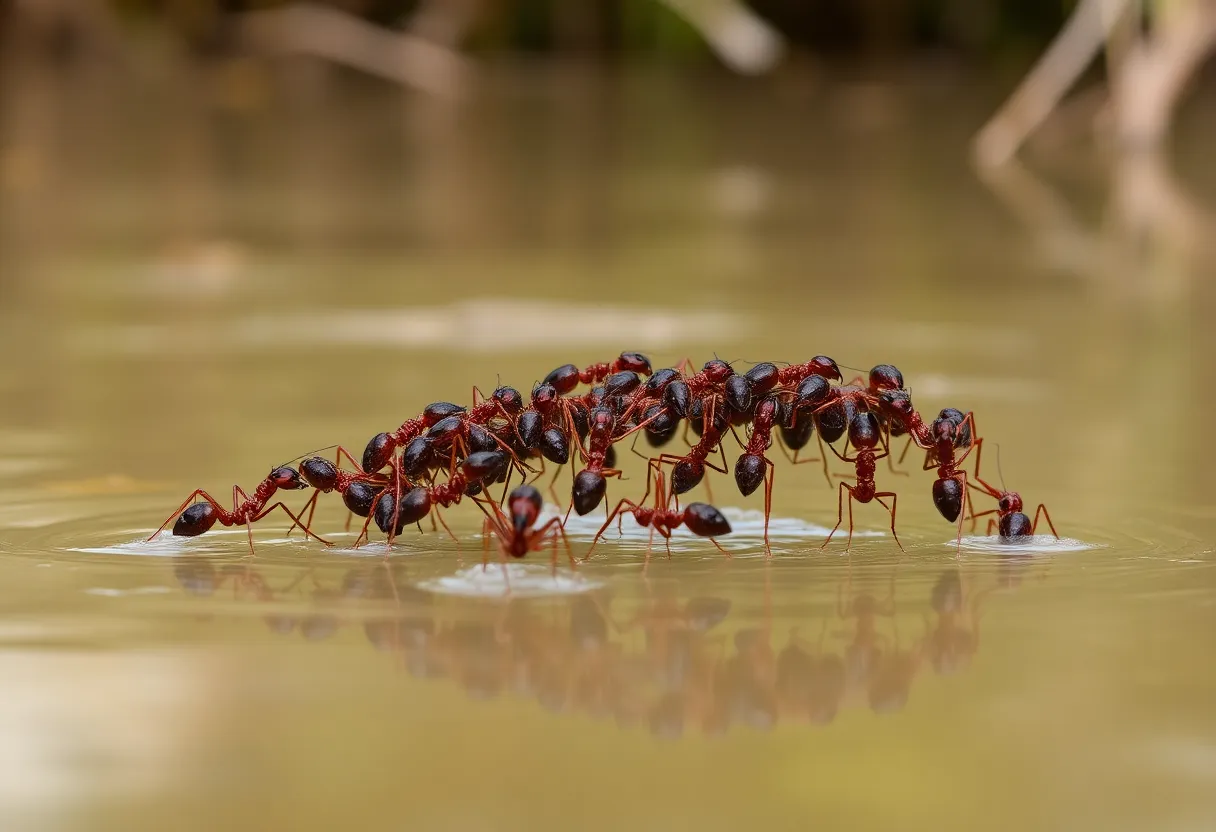
Austin, Texas — Residents have been observing an unusual phenomenon: fire ants floating on floodwaters, forming living rafts made up of their own bodies. This behavior has caught attention after a video surfaced, showing a raft of fire ants drifting on Lake Travis. When faced with flooding that inundates their underground nests, fire ants have the remarkable ability to link their legs and jaws together, creating buoyant mounds capable of supporting thousands of ants.
These living rafts are not just a survival tactic; they demonstrate the resilience of fire ants in the face of natural disasters. Even when clustered tightly together, the ants remain capable of biting or stinging if their rafts are disturbed, which highlights their ability to protect themselves during such events.
Researchers at Texas A&M University are actively examining how fire ants react to these flooding conditions. The self-assembling behavior displayed by these insects has garnered significant interest from scientists. Ed LeBrun, a research scientist at the University of Texas’ Brackenridge Field Lab, has explained that fire ants are believed to be the only ant species that can create such rafts. While other ants may employ similar strategies to form bridges, the construction of rafts is unique to fire ants.
Originating from the riverbanks of South America, fire ants have undergone adaptations over time that enable them to survive flooding by forming rafts. When these rafts are carried downstream, the fire ants eventually disassemble upon reaching dry land and reconstruct their nests, carefully replicating the original layout.
Beyond just scientific curiosity, the rafts formed by fire ants are inspiring new developments in material science. Taylor Ware, an associate professor at Texas A&M University, is using insights from the ants’ rafting technique to create a new type of rubber material. This innovative rubber is composed of tiny ribbons that can alter their shape in response to heat and cooling, mimicking the dynamic assembly process seen in fire ants.
Ware’s research has resulted in the creation of a unique material with potential applications in various fields, including motors and medical devices, particularly in wound healing. The development of this technology has received funding from prominent organizations, including the National Science Foundation, Army Research Office, and National Institutes of Health. While the new material is still undergoing testing, it is anticipated to reach the market in the coming years.
The significance of this research lies in its potential to enhance our understanding of natural assembly processes and their applications in technology. LeBrun’s ongoing studies emphasize the importance of observing and documenting natural behaviors in order to inspire future innovations. The study of fire ants and their rafting behavior may pave the way for advancements that bridge the gap between biology and engineering.
This fascinating interaction between ecology and technology highlights how natural phenomena can lead to practical solutions in human-designed systems. As such research progresses, the adaptation strategies perfected by fire ants could be utilized in ways that benefit a range of applications, from environmental management to the development of new materials.
Deeper Dive: News & Info About This Topic
HERE Resources
New Jersey Wildfire Ignited by Young Man’s Actions
California Bar Exam Under Fire: AI Questions Spark Controversy
Brazos Valley Cities Receive Major Infrastructure Funding
Bryan ISD Reassures Community Amid ICE Rumors
New Tourism Committee Established in College Station
Political Developments and Local Incidents in Brazos County
Additional Resources
- The Hill: Texas Floods, Fire Ants Raft on Lake Travis
- Statesman: Fire Ant Bites and Rare Disease
- KXAN: Fire Ants Inspire Transforming Rubber Technique
- Wiley Online Library: Research on Fire Ant Behavior
- Patch: College Student and Fire Ant Discovery
- Wikipedia: Fire Ant
- Google Search: Fire Ants Rafting
- Google Scholar: Fire Ant Behavior
- Encyclopedia Britannica: Fire Ant
- Google News: Texas Fire Ants

Author: STAFF HERE COLLEGE WRITER
The COLLEGE STATION STAFF WRITER represents the experienced team at HERECollegeStation.com, your go-to source for actionable local news and information in College Station, Brazos County, and beyond. Specializing in "news you can use," we cover essential topics like product reviews for personal and business needs, local business directories, politics, real estate trends, neighborhood insights, and state news affecting the area—with deep expertise drawn from years of dedicated reporting and strong community input, including local press releases and business updates. We deliver top reporting on high-value events such as the Brazos Valley Fair & Rodeo, Chilifest, and Aggie Muster. Our coverage extends to key organizations like the Bryan-College Station Chamber of Commerce and United Way of the Brazos Valley, plus leading businesses in education, biotechnology, and retail that power the local economy such as Texas A&M University, Fujifilm Diosynth Biotechnologies, and H-E-B. As part of the broader HERE network, including HEREAustinTX.com, HEREDallas.com, HEREHouston.com, and HERESanAntonio.com, we provide comprehensive, credible insights into Texas's dynamic landscape.